| Category | SEO |
|---|---|
| Type | Doc |
| Last Modified | 8 February 2023 |
| Location | Assets (SEO) > ASSETS – Content > Topical Authority Content Map |
Copy of ⭐Authoritative Writing Guidelines
Authoritative Content Writing Guidelines
Outline
This document gives guidance on writing authoritative content that is inline with the topical authority content strategy being implemented on your site. The main aim of authoritative content is to write from a place of authority and expertise. You are trying to inform users about the topic, not trying to sell a product or push a brand.
Here are some examples of exemplary Authoritative Content that has been structured using a Topic Cluster Model:
- Instagram Marketing: The Ultimate Guide
- What is cryptocurrency and how does it work?
- Beginner's Guide to buying coffee beans online [2020 Edition]
- How to Start Investing in Stocks: A Beginner's Guide
Topical authority can be defined as ‘depth of expertise’ and is achieved by regularly writing original, high quality content that fully covers the topic/query it revolves around. For instance, the topic ‘movies’ is very broad but there are many subtopics within the topic, like ‘romance movies or ‘scary movies’. Since the topic ‘movies’ is so broad, the number of subtopics is vast.
Within this document, we have created guidelines for creating authoritative content. When creating content with the intention of building topical authority, following these guidelines will help encourage Google to use your excerpts from your content to answer popular queries.
Content Guidelines
Avoid Keyword Stuffing
Write naturally without focusing on keywords. The optimisation of keywords and interlinking will be done by us after the content is written.
Avoid Abstract Analogies
The content does not need to be written in a boring way, in fact it is better to make it engaging. Interesting content will always be better for the user and the search engines, however, we want to write the information effectively and avoid abstract concepts if possible.
Don’t write from a brand perspective
Using informative language in these articles is key. Don’t use language like ‘we think’ or ‘our company believes’ but instead use ‘you should’ or ‘it is’. You want to position yourself as an authority on the subject, so that Google uses your articles for featured snippets to answer specific queries. With this in mind, having a sentence that directly and concisely answers the question is ideal.
Content should be as short as possible and long as necessary.
The content should not try to reach a word count, it should just address the question with all necessary information while being as concise as possible.
Use a “source” as an authority before giving a statement.
Google respects links coming in, but it also looks at the links going out. When you are stating something as a fact, if you can source a website with a lot of authority like a .gov site Google will see that as a good indicator that the content on this page understands the topic. Following this, make sure that you are using factual information. If Google does not think that your information is factual, you will not rank.
Never give your opinion
Content should not contain opinions, do not use phrases such as ‘I think’ or ‘we think’. The authoritative content you are writing needs to be rooted in fact and preferably not controversial or based on opinion.
Content for the core topic/pillar page should be evergreen
Content should be written in a way so that it stays evergreen. Evergreen content is content that does not lose relevance over time, so it is always relevant. When writing content for your pillar page, avoid using phrases like ‘last month’ or ‘this week’. New content that is relevant to the topic is fine, but more evergreen language should be used, for example ‘recent studies show’ or ‘new strategies include’
Become an Authority
You’re aiming to become an authority within your sphere to build domain authority, which will increase overall site ranking. Becoming an authority by creating relevant, evergreen content that other sites can reference shows that your content is accurate and valuable to people searching for queries relating to it.
Content Structure
Formatting, and the way in which the content is presented on the page is just as valuable as the content itself. There are a few ways to optimise page structure, which we have detailed below.
Heading Structure (H1 & H2)
The site should have a clear heading structure for each new subtopic/section of the page. Each page should be structured with one clear H1 heading being the page title.
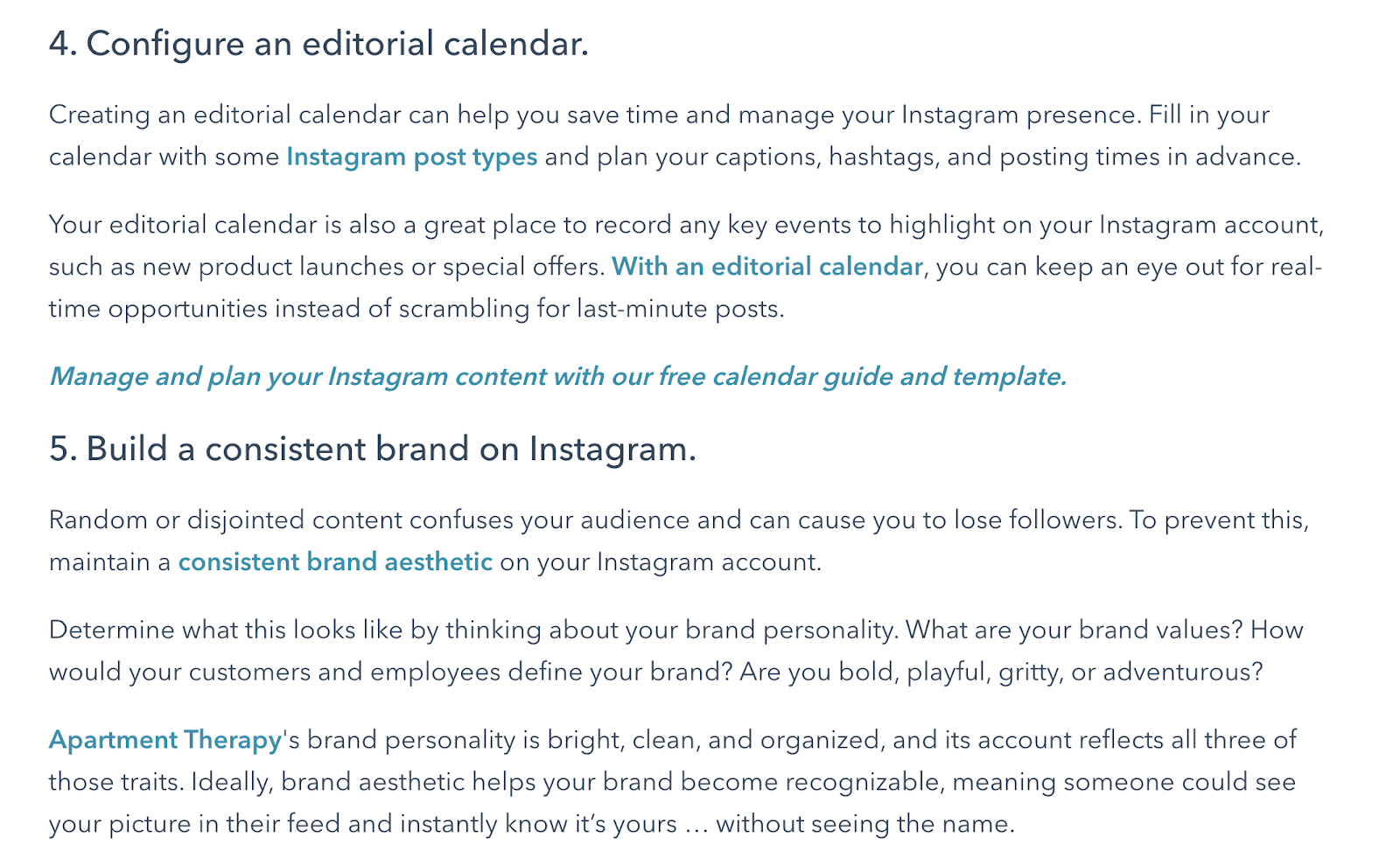
H2s should be the heading for each question or topic on the page. Use headings and subheadings to organise and categorise information. Most people skim over a page, so you want to make your most important information stand out and easy to find.
Table of Contents
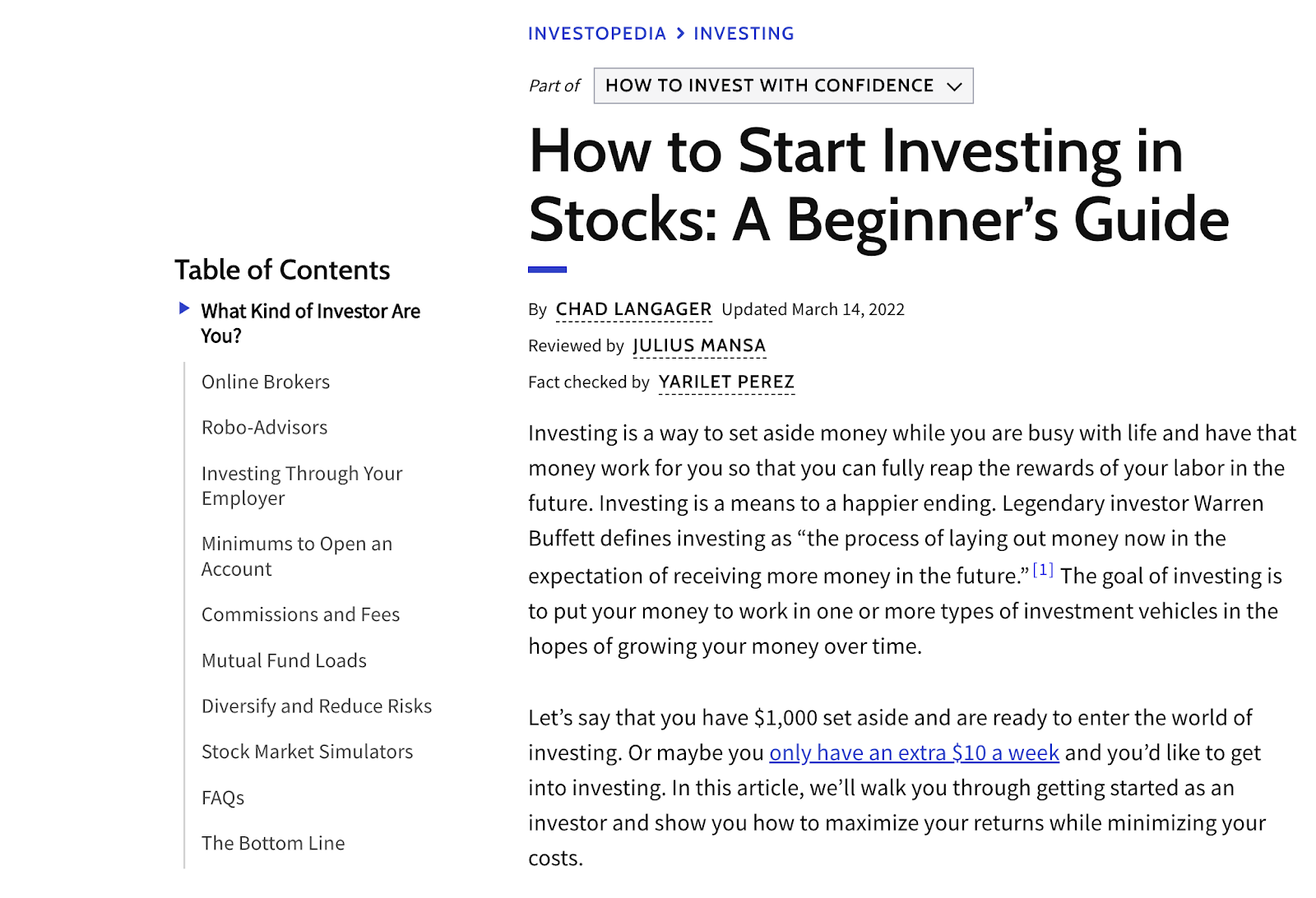
A table of contents, containing links to each heading on the page that will scroll the user to the heading location, is very important for both user experience and crawlability by search engines. Find examples of how to format a table of contents in Appendix One.
Grammar
Writing using the correct grammar and spelling for the region you are working within is important to both UX and SEO. Your sentences and the language you use should be simple and easy to follow and understand.
Appendices
Appendix One: Table of Contents Examples
Example 1: Sidebar Table of Contents
Example 2: Index of Importance
Appendix Two: Headings & Content Examples
Example 1: Numbered List
Example 2: Questions